
Exclusive Local Listing Spotlight: Custom Waterfront Estates in Huntington Harbour
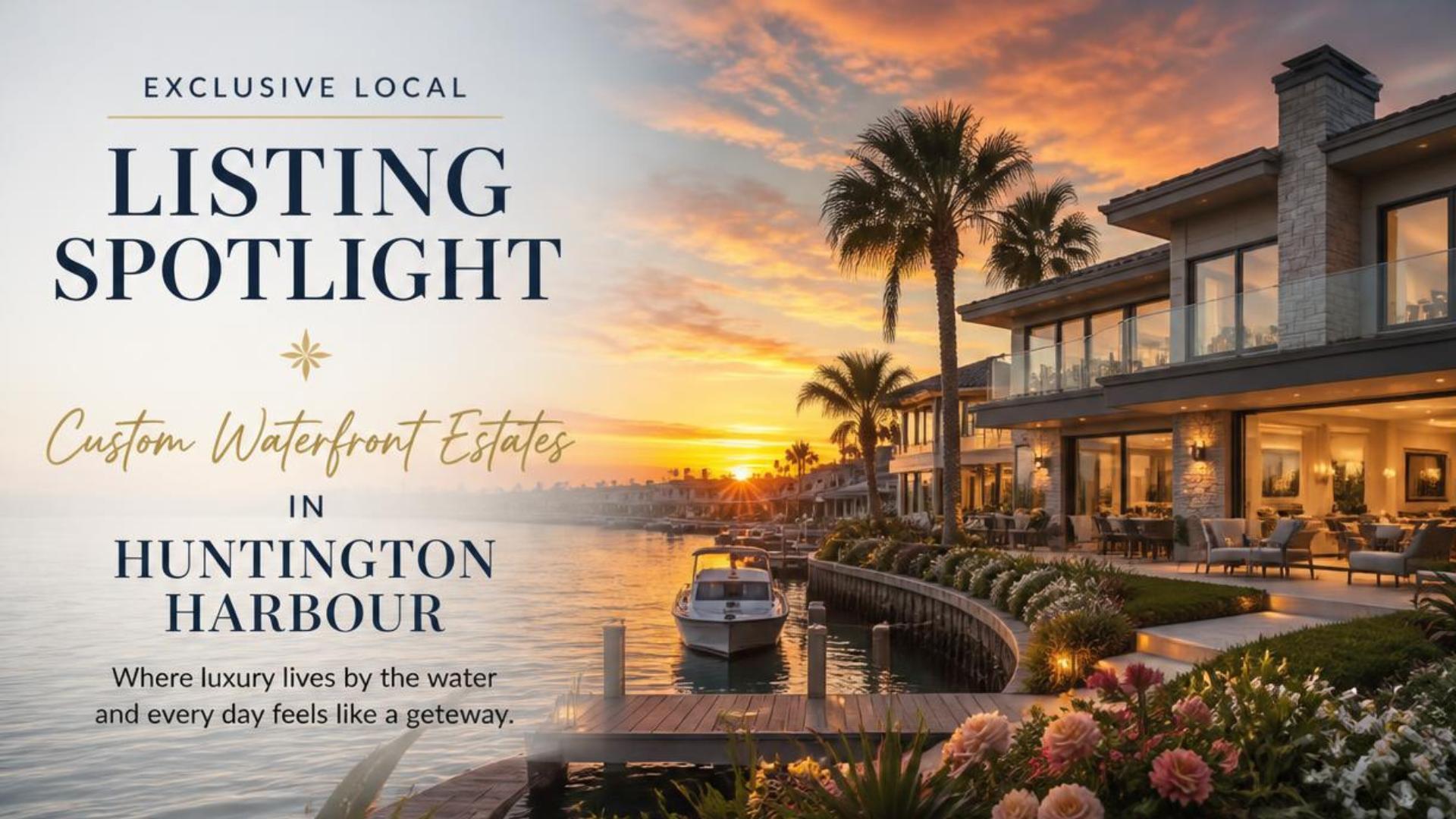
Huntington Harbour is a master-planned, highly exclusive residential marina community encompassing approximately 680 acres in northwestern Huntington Beach. Developed in the mid-1960s, the harbor's quiet channels and five residential islands were meticulously carved from the historic Sunset Bay Estuary. Strategically bracketed by the 1,200-acre Bolsa Chica Ecological Reserve to the south and the Seal Beach Naval Weapons Station to the north, this unique geography insulates the harbor from dense coastal commercialization. The result is a quiet, highly secure, and deeply private environment for its residents.
For luxury buyers and boating enthusiasts, the primary appeal of Huntington Harbour is the ability to dock a vessel directly behind a private residence, creating a seamless backyard-to-ocean navigation experience.
The Boater’s Paradise and Direct Ocean Access
The waterways of the harbor maintain depths of 15 to 20 feet along the primary navigation channels, allowing for smooth passage of luxury motor yachts, sportfishers, and cruising vessels. To reach the Pacific Ocean, vessels transit northwest into Anaheim Bay. This path passes beneath the Pacific Coast Highway (PCH) bridge, which features a fixed vertical clearance of 23 feet measured from Mean High Water. While this height prevents tall-masted sailing vessels from clearing the bridge, it is highly accommodating for power-driven yachts and cruisers, offering direct ocean transit without the clearance issues or bridge-opening delays common in other residential harbors.
Navigational safety was significantly modernized with the opening of a dedicated civilian small craft channel in Anaheim Bay. Measuring approximately 1,200 feet long and 200 feet wide, this channel is roughly 25% wider than the historical shared channel. Its primary purpose is to establish physical separation between civilian recreational boaters and military vessels. Previously, civilian transit was subject to unpredictable closures lasting from 45 minutes to several hours during military operations. The dedicated civilian channel has permanently resolved these bottlenecks, ensuring continuous, reliable ocean access.
Private Dock Privileges
Within individual residential parcels, private dock privileges represent a massive portion of a property's overall capital value. The highest market premium is concentrated on properties featuring private 50-to-60-foot boat slips, with select estates on larger island corners supporting multi-vessel docking layouts of up to 80 feet.
Under modern marine standards, mooring heavy vessels requires specialized engineering. When expanding a dock to accommodate larger hulls, owners must widen the dock floats. This extra width is a physical necessity; heavier, wider floats act as wave attenuators. They match the vertical movement of the dock to the motion of the heavy vessel during tidal surges, preventing damage and shear stress on the concrete guide piles.
Waterfront Architectural Features and Municipal Codes
The custom estates lining the waterways of the harbor are engineered to maximize visual and physical integration with the water. Architectural styles like Mid-Century Modern, Coastal Contemporary, and Mediterranean-inspired designs rely on floor-to-ceiling glass walls to frame harbor views and open-concept layouts that transition seamlessly into custom seawall-adjacent patios.
To maintain structural safety and open navigation, all waterfront development is strictly governed by the City of Huntington Beach’s Local Coastal Program (LCP) under Implementation Plan Chapters 210 and 213:
- Cantilevered Decks: Private decks are permitted to extend a maximum of 5 feet beyond the physical bulkhead (seawall) line over the water. To keep public waterways free of navigational hazards, these overwater decks must be supported entirely by the landward foundation of the home, no vertical supports, pilings, or structural columns may be placed in the water.
- Guardrails and Glass Windscreens: Decks must feature a protective guardrail along their waterward perimeter, maintaining a height of 3.5 feet (42 inches). Transparent glass windscreens are permitted up to a maximum height of 7 feet above the deck surface to mitigate coastal winds while preserving scenic views.
- Bird-Strike Prevention: Due to the harbor's proximity to the Bolsa Chica Ecological Reserve, the California Coastal Commission mandates bird-safe designs. Overwater deck railings, windscreens, and harbor-facing windows must utilize materials like vertical cable systems, wrought iron, frosted glass, or transparent panels treated with an interlayer of UV-reflective glazing that is visible to birds but transparent to humans.
- Runoff and Drainage Design: To protect the harbor's water quality, decks must be designed with split drainage systems. Rainwater is directed into dedicated area drains, routed through landward catch basins, and treated to remove debris and residential pollutants before being slowly discharged into the canals.
Island-by-Island Breakdown
The residential core of Huntington Harbour is defined by its five man-made islands, each constructed with distinct layouts and lot-to-water ratios:
- Admiralty Island: Boasting only 90 home sites, Admiralty represents the pure nautical layout of the original 1963 development. Almost 100% of these properties feature direct canal frontage with private boat docks. Homes are highly customized, typically ranging from 2,000 to 5,500 square feet. Its immediate proximity to Peter’s Landing Marina allows residents to easily walk to commercial dining, retail, and yacht services.
- Davenport Island: Located on the southern border of the harbor, Davenport consists of 227 home sites evenly split between on-water and landlocked, off-water lots. Because half of the island's lots do not touch the water, Davenport offers a tiered entry point into the harbor market, with off-water homes starting near $2.0 million and premier waterfront estates exceeding $6.0 million.
- Gilbert Island: The smallest of the harbor islands, containing only 100 home sites. Two-thirds of the properties are situated directly on the water. Gilbert features highly stable, multi-generational ownership, and public listings are exceptionally rare, often averaging only one or two opportunities per year.
- Humboldt Island: A spacious enclave of 335 homes where approximately two-thirds of the properties sit on the water. Humboldt's primary advantage is its orientation toward Christiana Bay, providing waterfront estates with wide-angle, panoramic water views that are far less restricted than the narrow canal views of smaller islands.
- Trinidad Island: Widely considered the most luxurious and prestigious island in Huntington Harbour, Trinidad consists of approximately 200 custom single-family residences. Almost all perimeter properties feature private docks ranging from 35 to 80 feet along the Main Channel or Trinidad Bay. The island is highly sought after by families due to its manicured landscaping, private sandy beach, and beautiful community parks like Conrad Park.
Market Trends for Harbor-Front Properties
The real estate market in Huntington Harbour is defined by structural scarcity. Because the area is fully built out, inventory is finite, which historically supports property values through market cycles.
- The Waterfront Premium: While inland single-family homes in the area start around $1.2 million, true waterfront homes featuring private boat docks begin at $3.5 million and scale up to $11.75 million, representing a valuation gap of over 190% driven solely by water access.
- Price per Square Foot: The average citywide price in Huntington Beach stands at $779 per square foot. In contrast, waterfront homes in the harbor regularly exceed $1,000 per square foot, climbing significantly higher for premier custom island estates.
- Days on Market: Transactional speed shows a clear relationship with price point. Well-priced, non-waterfront condos and inland homes move rapidly, with pending periods averaging under 21 days due to a larger pool of buyers. Premium waterfront assets experience a smaller pool of high-net-worth buyers, with average days on market ranging between 30 and 45 days.
Waterfront-Specific Due Diligence
Acquiring a waterfront estate in Huntington Harbour requires highly technical due diligence that goes far beyond a standard residential home inspection. The seawall (bulkhead), private dock, and supporting pilings are the most expensive components of the property, and their maintenance and compliance are the sole responsibility of the property owner.
- Seawall and Bulkhead Diagnostics: The bulkheads supporting the islands were constructed in the 1960s using reinforced concrete caps supported by vertical timber piles driven into the harbor bed. They are under constant stress from tidal pressure, saltwater corrosion, and marine boring organisms. Buyers must retain a qualified marine specialist to perform a comprehensive bulkhead dive survey to check for concrete cracking, rust stains from corroded tie-back anchors, and soil voids behind the wall.
- Sovereign Land Leases: Because the harbor channels are public tidelands, waterfront property owners do not own the submerged land beneath their private docks. Homeowners must secure a sovereign land lease from the California State Lands Commission (CSLC) to authorize the encroachment of private docks, access ramps, and cantilevered decks. These leases are typically issued for 10-year terms and carry annual rental fees (averaging approximately $3,890 per year), making this an essential carrying cost to verify during escrow.